
At first glance, choosing the right plastic for a process air system may seem like a minor technical detail. In practice, however, it is one of the most important design decisions of all, because using the wrong material will, at best, result in a shorter service life and, at worst, lead to system failure or a safety hazard.
PVC (PVC-UV), PP, PPs, PPs-el, PVDF, PE: Seven materials, a wide range of properties, and very different requirement profiles depending on the application. This article provides a structured overview of which material is the right choice in each situation.
Why the choice of materials is so crucial for process air
Process air systems do not transport neutral ambient air. They exhaust chemically contaminated air, whether from pickling baths, laboratory fume hoods, electroplating tanks, cleanrooms, or ATEX zones. The media being transported may contain acids, alkalis, solvents, or be electrostatically charged. In addition, there are requirements regarding temperature resistance, fire protection, and, in some cases, regulatory certifications.
Metal duct systems fail quickly in these environments. Plastic is the solution here. But the specific type of plastic depends on the exact application, the medium being transported, and the applicable regulations.
An Overview of the Seven Beck Materials
PVC-U – Primarily for Markets Outside Germany
PVC-U (rigid polyvinyl chloride) is primarily used in markets outside Germany for ventilation systems exposed to chemicals. It is generally resistant to acids and alkalis at temperatures ranging from -5 to +50 °C. Suitability for a specific medium must be verified on a case-by-case basis.
PVC-UV – PVC for outdoor use
PVC-UV is the UV-stabilized version of standard PVC and was developed specifically for outdoor use. Roof ducts, exhaust air ducts, and all system components exposed to prolonged sunlight benefit from its increased weather resistance. With a temperature range of up to +50 °C, it matches that of standard PVC; the key difference lies in its long-term stability under UV exposure.
PP – Chemically Resistant, Versatile
Polypropylene (PP) is one of the most widely used materials in chemical plant engineering—and for good reason. In general, polypropylene (PP) is resistant to acids, alkalis, and weak solvents, but not to oxidizing solvents and halogens. Resistance to a specific medium must be verified on a case-by-case basis. With an operating temperature of up to +80 °C, PP is suitable for more demanding process air applications in electroplating facilities and general production areas. In exhaust air systems, PP is typically used for process exhaust air without increased fire resistance requirements, such as in outdoor applications.
PPs – PP with Fire Protection
PPs (flame-retardant polypropylene) combines the chemical properties of PP with a decisive advantage: fire protection class UL 94 V2 and DIN 4102 B1. This makes PPs the top choice wherever fire safety regulations must be complied with, particularly in ventilation systems inside buildings. The operating temperature range is also up to +80 °C. PPs is the standard material for indoor installations in electroplating facilities, production halls, and laboratories where documented flame-retardant behavior is required. It is typically used for chemically contaminated process exhaust air in indoor environments with corresponding fire safety requirements.
PPs-el – where fire safety and ESD protection come
together PPs-el takes it a step further: It combines the flame-retardant properties of PPs with electrical conductivity (surface resistance approx. 10⁵ ohms). This makes it the material of choice in areas where electrostatic charging poses a real hazard—that is, wherever flammable dusts, solvents, or gases may be present in the air. Typical applications include ATEX-classified zones, laboratories handling potentially explosive substances, and production areas in the electronics industry. The operating temperature range is up to +70 °C. It is selected for process exhaust air where electrostatic dissipation is additionally required, e.g., due to an explosion protection rating.
PVDF – the high-performance solution for extreme requirements
Polyvinylidene fluoride (PVDF) has the widest operating temperature range in the Beck product line, from -20 °C to +120 °C. It is generally resistant to organic acids and inorganic chemicals, but not to ketones and fuming sulfuric acid. It is also listed according to FM 4910. PVDF is suitable for cleanrooms, high-purity media handling, and semiconductor equipment, where, in addition to chemical resistance, high standards for particle-free conditions and fire protection apply. Resistance to the specific medium must be verified on a case-by-case basis.
PE (PE-HD) – robust, cold-resistant, UV-stable
Polyethylene (PE-HD) rounds out the lower end of the material range: With an operating temperature range of -20 °C to +70 °C, PE is particularly suitable for outdoor applications and use at low temperatures. PE is UV-resistant, impact-resistant, and chemically stable—ideal for roof piping and outdoor installations where low-temperature performance and weather resistance are required.
Applications and the Right Materials
Electroplating and Production Areas
Electroplating facilities are among the most chemically demanding environments for ventilation systems. Acids, alkalis, and corrosive vapors from pickling baths and electroplating tanks require materials with broad chemical resistance. At the same time, fire safety requirements in production facilities often preclude the use of standard PP.
The standard solution for electroplating facilities and general production areas is PPs—it combines chemical resistance with proven fire protection. Where higher temperatures up to +80 °C occur, PPs is the safe choice. For markets outside Germany, PVC-U is also an option (-5 to +50 °C), provided that the medium, temperature, and pressure conditions are suitable.
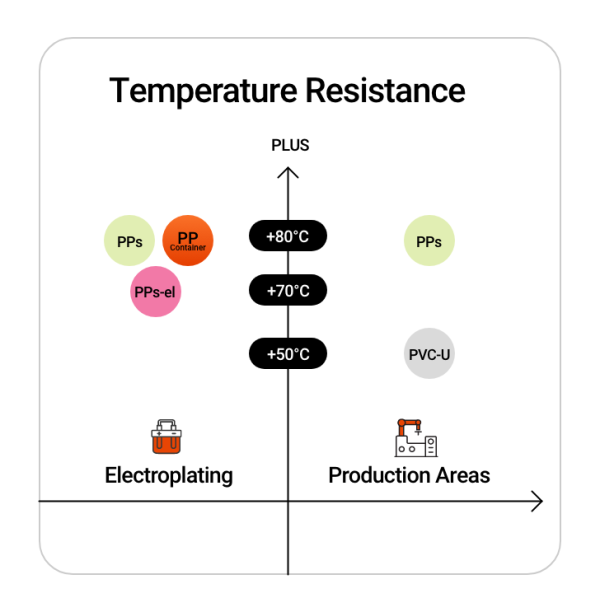
Material Selection for Ventilation in Electroplating: PPs, PP, PPs-el, and PVC-U Based on Operating Temperature
Roof Ducts and Outdoor Installations
Special requirements apply to roof piping and all outdoor components: UV resistance, weather resistance, and—depending on the location—low-temperature performance. For markets outside Germany, PVC-UV rated up to +50 °C is a viable option. PE-HD extends the operating range down to -20 °C and is particularly suitable for systems in colder environments or those exposed to cold air. For demanding outdoor applications with high chemical resistance requirements, PVDF remains the highest-performance option.
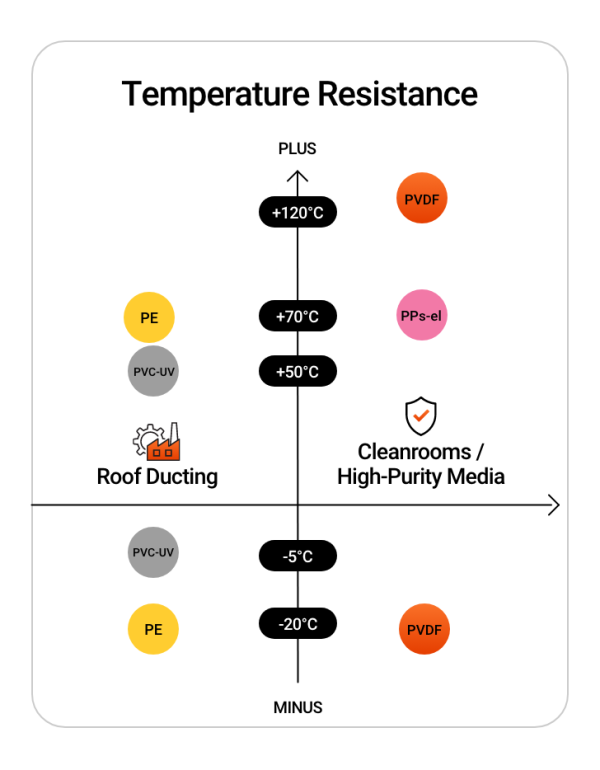
PVDF Ventilation Pipe Temperature Resistance: Material Selection for Cleanrooms and Roof Ducts
Cleanrooms and High-Purity Media
In cleanrooms—particularly in the semiconductor, pharmaceutical, and biotechnology industries—there is no room for compromise. The requirements for particle-free conditions, chemical purity, and fire safety are the highest possible. PVDF is listed in the Beck product range as FM 4910 and covers the widest temperature range, from -20 °C to +120 °C. Resistance to the specific medium must be verified on a case-by-case basis.
Laboratories and ATEX Areas
Laboratories often combine several requirements at once: chemical resistance, fire safety, and—depending on the laboratory—ESD protection as well. PPs meets the standard requirements. However, as soon as potentially explosive substances are involved or ATEX zones are present, PPs-el is the right choice. Its electrical conductivity prevents electrostatic charging in the duct system and thus eliminates a potential ignition source, while also meeting the fire safety requirements documented in UL 94 V-0.
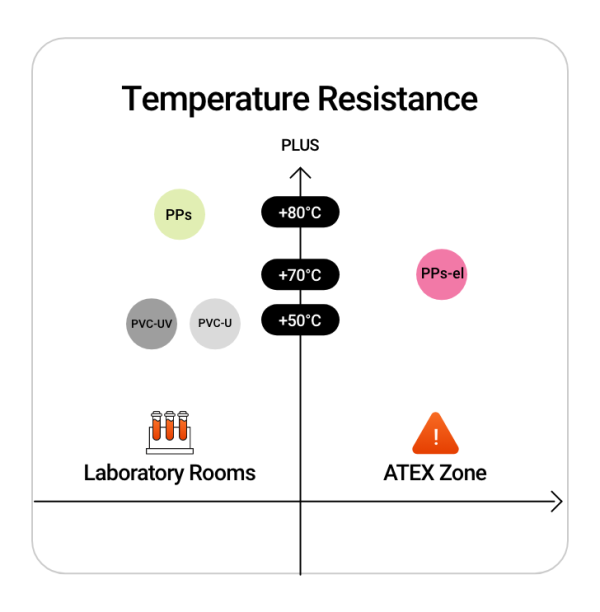
PPs-el ATEX Ventilation: Material Selection for Laboratories and Potentially Explosive Areas
The Decision: Which Material for Which Requirement?
The choice of material is essentially guided by four key questions:
- What is the operating temperature?
PVC-U and PVC-UV are suitable up to +50 °C. PP, PPs, and PPs-el can withstand temperatures up to +80 °C and +70 °C, respectively. PVDF covers the widest range—from -20 °C to +120 °C. - What medium, under what operating conditions?
There is no universal ranking. How well a material withstands a chemical always depends on the planned operating conditions, particularly temperature as well as pressure and vacuum loads. - What fire safety requirements apply?
As soon as a fire safety classification is required, standard PP is ruled out. PPs meets UL 94 V-2 and DIN 4102 B1, while PPs-el meets UL 94 V-0. PVDF is listed under FM 4910. - Are there ATEX or ESD requirements?
In that case, PPs-el is the only option that combines flame resistance and electrostatic dissipation in a single material.
You make the right choice with the right partner
Not all plastics are created equal. This is clearly demonstrated by a comparison of the seven Beck materials. Each material has its own optimal set of requirements, and the right choice always depends on the specific application, the medium being conveyed, the temperatures, and the applicable regulations.
Beck offers the entire range of materials from a single source: From PVC for markets outside Germany to FM 4910-listed PVDF applications. And if you’re not sure which material is right for your project, just contact us—we’ll help you make the right material decision.
By the way: For your specific design work, Beck provides CAD data for process air components available for download. This ensures your material selection can be directly incorporated into the planning process.