
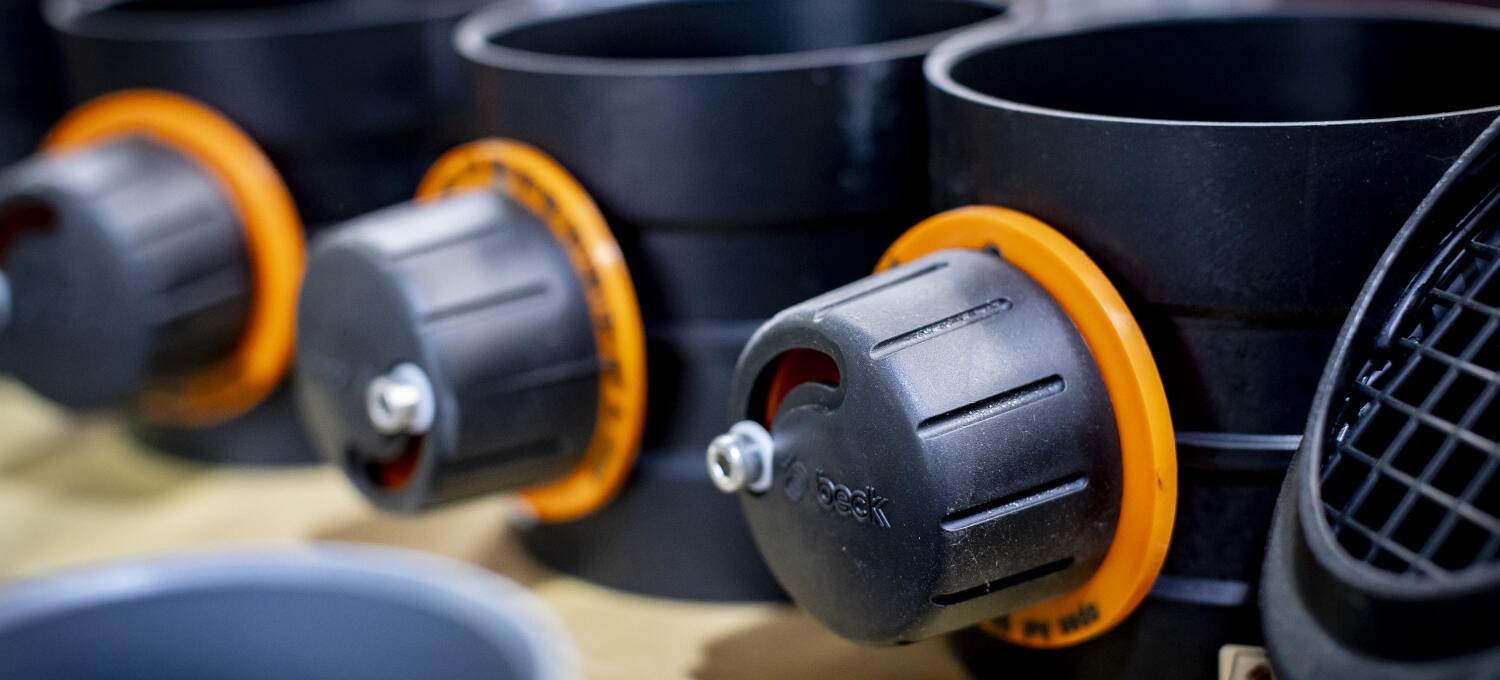
In many facilities handling chemically contaminated process air, simply exhausting the air is not enough. Electroplating tanks, laboratory fume hoods, or individual production areas require ventilation systems that can be precisely regulated and completely shut off when necessary—for example, during maintenance work, during partial-load operation, or to shut down individual sections of the plant. Metal dampers quickly reach their limits in these applications: Corrosive media attack the housing and seals, and the damper loses its airtightness over time. A damper made of chemically resistant plastic permanently solves this problem, provided that the material, actuator, and design are suitable for the specific system.
In this article, you’ll learn which type of actuator is right for your system, how standard, reinforced, and tight-sealing designs differ, and which material is suitable for your process air.
What a Throttle Valve Does in a Process Air System
Dampers are used in ventilation and air-conditioning systems to throttle or shut off airflows (sometimes also referred to as shut-off dampers). They consist of a housing, a damper disc, a single-ended drive shaft, and a bearing journal. Depending on the system, the damper performs two different functions: the precise regulation of airflow through partial openings or the complete shutoff of a duct. Which design is suitable depends primarily on the required tightness—more on that in a moment.
Be in control: You can also find more information on our product page for butterfly dampers and check dampers.
Why Plastic Dampers Are an Advantage in Applications with Corrosive Process Air
At Beck, housings, shafts, and damper discs are manufactured from chemically resistant thermoplastic materials: PVC-U, PVC-UV, PP, PPs, PPs-el, PE-HD, and PVDF (polyvinylidene fluoride, a particularly highly resistant, high-performance plastic). This allows for the production of butterfly dampers for a wide range of process air applications, from moderately contaminated exhaust air to highly corrosive media. Which material is suitable in each individual case always depends on the medium, concentration, temperature, and the applicable fire safety or electrical conductivity requirements. A blanket recommendation such as “PP is sufficient for acids” falls short here; the specific resistance to the actual medium being handled should always be verified on a case-by-case basis. You can find a detailed comparison of all materials, along with application recommendations for electroplating, cleanrooms, laboratories, and ATEX areas, in our latest post.
Manual, electric, or pneumatic: Choosing the Right Drive Type
Not every system requires automated damper control, but where it makes sense, the damper should be designed for it. Beck offers three actuator options:
The manual damper is available in two versions: In 15° increments with a spring-loaded adjustment knob that clicks into place, or continuously adjustable with a 0- to 90-degree scale ring and a stainless steel locking screw for securing the position. In both versions, the shaft is sealed with two media-resistant O-rings; the continuously adjustable version additionally features a third seal that can be retightened even when the damper is installed. This eliminates the need to remove the damper should the seal lose its effectiveness.
Electric and pneumatic damper actuators are designed similarly to the continuously adjustable series. The motor brackets are designed to fit standard actuators; custom brackets are available for non-standard motor types. For systems with a higher-level control system or that require frequent adjustment, the electric or pneumatic version is usually the more practical choice; for control loops that are occasionally readjusted manually, the manual version is sufficient.
Want more information?
You can also find all dimensions, drive combinations, and technical details in our product catalog.
Simple, reinforced, or tight-sealing: The design of the damper blade determines how well it seals
Not every damper needs to be able to completely shut off a line. Beck therefore distinguishes between three types of damper blades. The standard and reinforced versions are suitable for regulating airflows but have limited tightness when closed. The standard version meets the tightness class specified in DIN EN 12237.
Where a duct must be completely sealed off—for example, for maintenance sections or to safely isolate system components from the airflow—the tight-sealing butterfly damper conforming to DIN EN 1751-4 is used. An additional, circumferential elastomer seal ensures that the damper blade makes full-surface contact with the housing stop. For reasons of ring stiffness, this version is available exclusively with a flange connection, not with a socket.
Applications and Decision-Making Criteria for Planning
Plastic butterfly dampers are typically used in applications involving process air with chemical contamination: in electroplating, laboratory fume hoods, chemical production, and similar manufacturing areas. Three questions are particularly relevant when selecting the appropriate model:
- Does the damper need to regulate flow only, or does it also need to shut off the flow completely?
- Should it be controlled manually, electrically, or pneumatically?
- And which connection—socket or flange—is compatible with the existing piping system?
Only once these questions have been answered can the appropriate material be determined.
From Selection to Implementation
Beck supplies butterfly dampers in all of the materials and actuator types listed and can advise you on selecting the right model for your system. To assist with the actual design work, Beck also provides CAD data for butterfly dampers and other process air components for download, so that your decision can be incorporated directly into your planning.
Please contact us if you’re unsure which model, actuator, or material is the right choice for your system. We’ll advise you based on your specific process conditions.