
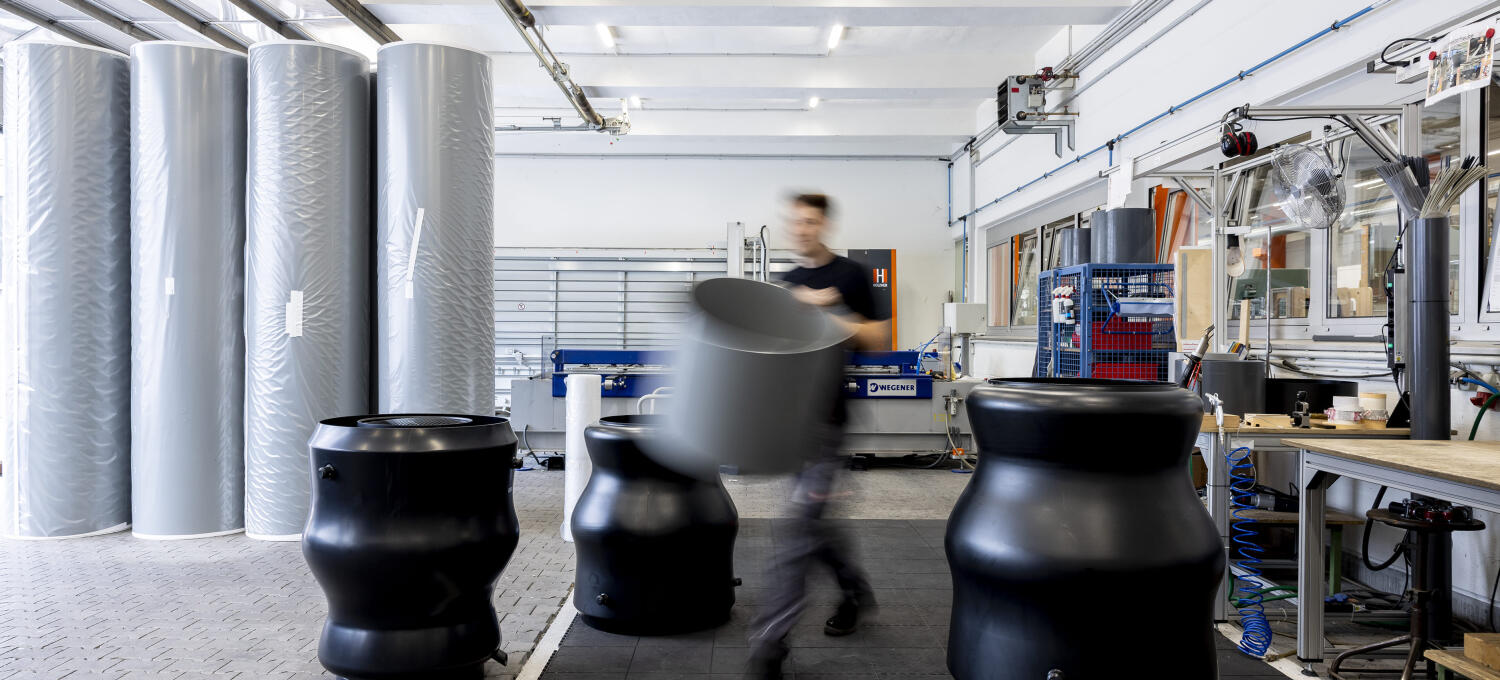
The exhaust duct ends at the roof outlet, where two requirements must be met: The exhaust air must be able to flow unimpeded straight up, and rainwater must not enter the duct. A deflector hood meets both of these requirements. How well it performs depends on the details: the pressure loss, the drainage of rainwater, and the material that is suitable for the exhaust air being vented.
In this article, you’ll learn how a deflector hood works, what sets the Beck Rediff apart from conventional hoods, when the bypass version is a good option, and what materials are available.
How a deflector hood works
A deflector hood is mounted at the end of the pipe that runs over the roof and directs the exhaust air vertically upward. Inside, a collection funnel catches any rainwater that enters, and an eave drainpipe carries it outside. The pipe remains dry.
To ensure this, the hood must be installed vertically, regardless of the roof pitch. If it is installed at an angle, drainage through the eave water outlet cannot be guaranteed, and rainwater may enter the duct.
Be protected: You can also find more information on our product page for roof hoods.
The Beck Rediff: less pressure loss, no downward blow-off
The Rediff is Beck’s own design and an evolution of the DSB exhaust hood. It differs significantly in both construction and performance:
- Seamlessly formed: The outer and inner shells are each made from a single piece of thermoplastic and are welded together to form a solid unit.
- Aerodynamic: There are no sharp leading edges, and the inner surfaces are very smooth. Compared to a conventional deflector hood, pressure loss is reduced by approximately 75%. This helps save energy.
- Low profile: The design allows for an extremely low overall height.
- No downward airflow: Due to the design, no part of the exhaust air can escape downward through the eave drainpipe. Any rainwater that enters is drained outward through it.
Rediff with Bypass
For systems in which the pollutant content of the exhaust air is to be reduced, the Rediff with bypass is available. It allows up to 20% of secondary air from outside to be mixed in.
Regardless of the hood selected, emissions must comply with the requirements of the TA Luft (Technical Instructions on Air Quality Control). These requirements must always be taken into account during the planning phase.
Nominal Sizes, Connections, and Features
The Rediff is available in nominal diameters from d 110 to d 630, with socket or flange connections. The product line is complemented by the DSB exhaust hood and, for large nominal diameters ranging from d 700 to d 1400, by the deflector hood. Special PVC-UV versions are available for connection to steel spiral-seamed ducts.
- Bird protection: available without pressure loss; optionally made of stainless steel.
- Transport and tie-down eyes: available on all exhaust hoods starting at DN 500, for use as needed.
- No cylindrical pipe connection: This prevents installation errors.
Dimension tables and drawings can be found in the product catalog for deflector hoods.
Rediff, DSB, and Deflektorhaube are available in PVC-U, PVC-UV, PP, PPs, PPs-el, PE, and PVDF. The best way to determine which material is suitable is to follow this order: first, assess chemical resistance to the exhaust air—that is, temperature, chemicals, and negative pressure. Next, consider regulatory requirements: if a regulatory agency excludes a material, it is not an option. Finally, consider the installation location, as some materials are not permitted for indoor use. As a general guideline:
- PP for process exhaust air without increased fire performance requirements, such as in outdoor applications.
- PPs for chemically contaminated process exhaust air indoors where applicable fire safety requirements are met.
- PPs-el when electrostatic dissipation is also required, e.g., due to an explosion protection assessment.
- PVC-U and PVC-UV are primarily for systems outside Germany; PVC-UV is UV-stabilized.
Compatibility with the specific medium must be verified on a case-by-case basis. You can find a detailed comparison of the materials in our article on material selection.
Frequently Asked Questions About the Deflector Hood
Does a deflector hood have to be installed vertically?
Yes, regardless of the roof pitch. This is the only way to ensure that rainwater is reliably drained through the eave drain.
What distinguishes the Rediff from the DSB exhaust hood?
The Rediff is an advanced version of the DSB. It has lower pressure loss, an extremely low profile, and its design prevents exhaust air from being blown downward.
Does the bird guard increase pressure loss?
No, the bird guard is available without causing any pressure loss.
From Planning to Implementation
CAD data for the roof hoods is available for planning purposes.
Does your installation situation differ from the standard? If so, we can assist you with a planning guide. Please contact us: We’ll advise you on selecting the hood, nominal diameter, and material.