
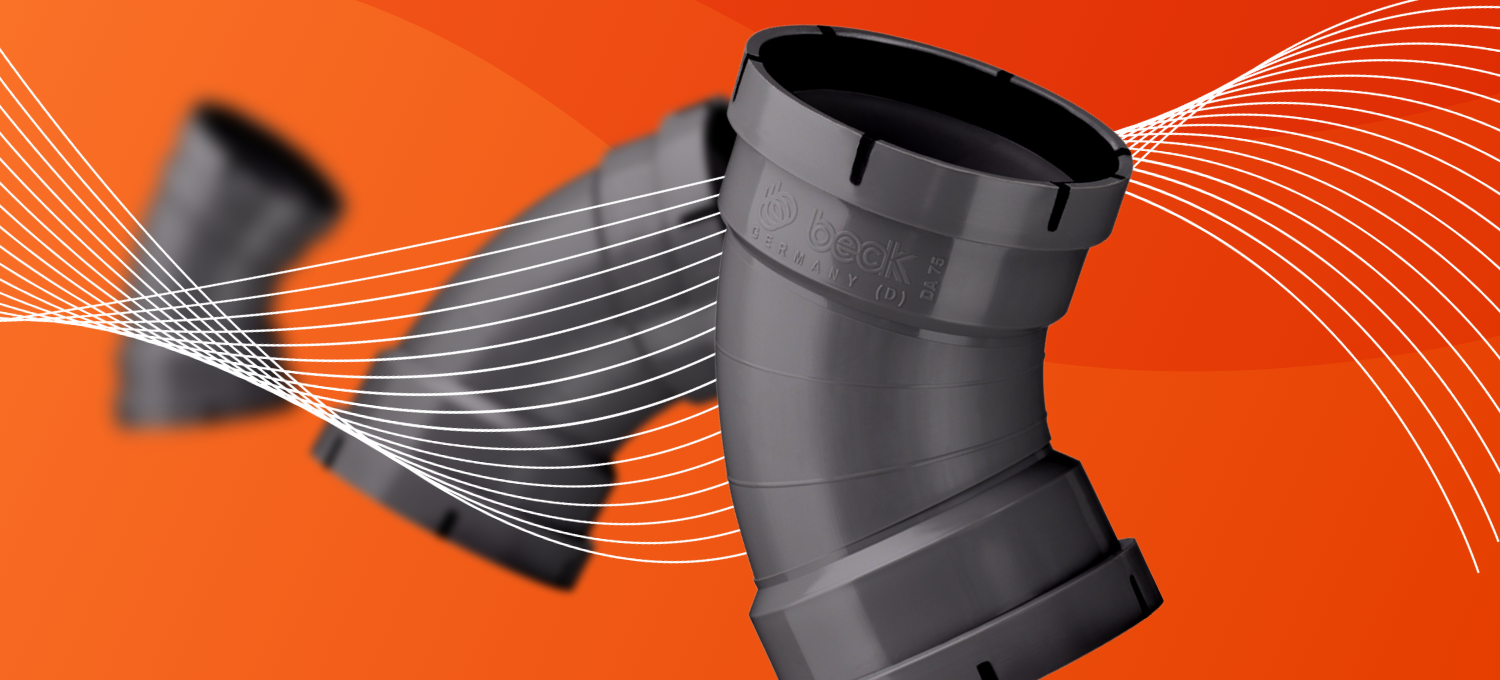
Welding fittings to pipes is a time-consuming process. It requires skilled personnel, time, and an easily accessible workspace—and these conditions aren’t always available at every point in a plant. This is exactly where Beck’s EffiTech plug-in system comes in: It’s a pipe connection that requires no welding; pipes and fittings are simply pushed together without tools or adhesives.
In this article, you’ll learn how the push-to-connect system works, what types of fittings are available, and which material is suitable for your process air.
How the connector works
Every EffiTech fitting features sockets with an integrated 5-layer elastomer lip seal. The sealing lips are angled relative to the axial direction, and the contact pressure increases with the load. An internal stop automatically aligns the pipe and fitting during insertion. The elasticity of the socket accommodates permissible variations in the pipe’s outer diameter within the tolerance specified by DIN.
The joint remains leak-tight up to a negative pressure of 10,000 Pa. Socket clamps are available for higher loads.
Installation is straightforward: lightly deburr the pipe ends, push them in until you feel resistance, and you’re done. The support rings inside the sleeves are removed just before installation.
Be fast: You can also find more information on our product page for the EffiTech plug-in system.
Product Line: Pipe Elbows, Plug-in Couplings, Reducers, T-Fittings
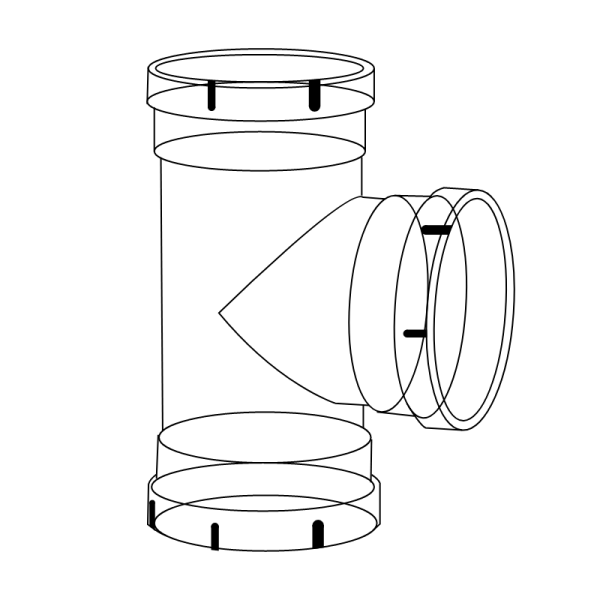
The system includes seamless pipe elbows ranging from 15° to 90°, double sockets, symmetrical reducers, and 90° T-pieces (with outlet pipes also available in 45° and 60°). All fittings are available in sizes from Ø 50 to Ø 315. The 90° elbows have a radius equal to the diameter. Dimension tables and drawings can be found in the EffiTech plug-in system product catalog.
Materials: PP, PPs, PE, and PPs-el
EffiTech molded parts are available in PP, PPs, PE, and PPs-el. The choice of material depends not on the type of connection, but on the application:
- PP for process exhaust air without increased fire performance requirements, such as in outdoor applications.
- PPs for chemically contaminated process exhaust air in indoor applications where applicable fire safety requirements apply.
- PPs-el when electrostatic dissipation is additionally required, such as due to an explosion protection assessment. In PPs-el, the lip seal is also made of an electrically conductive base polymer.
The order of testing always remains the same: first, chemical resistance (temperature, chemicals, negative pressure); then, regulatory requirements; and finally, whether the unit is installed indoors or outdoors. The permissible operating temperature depends on the material specifications of the selected material. Therefore, it is best to coordinate the design with us based on the medium and temperature. You can find a detailed comparison of the materials in our article on material selection.
Pipe Connections Without Welding: The Practical Benefits
The system offers flexibility, allows for installation by personnel without specialized expertise, and significantly reduces installation time. This also applies to hard-to-reach areas.
Installation time is reduced by up to 70% compared to conventional welded joints. Because no welding is required and installation is faster, disruptions to ongoing operations are correspondingly brief. The fittings are interchangeable and reusable, so modifications can be made without damaging the components.
In addition, the patented system connects different materials. In addition to plastic pipes, pipes made of steel, sheet metal, or aluminum can be connected. For example, an existing sheet metal pipe system can be supplemented with a flow-optimized plastic exhaust hood.
There is also the energy aspect: The flow-optimized fittings save up to 30% on energy costs.
An Overview of the Most Important Answers
Do I need tools for the EffiTech connection?
No. Pipes and fittings are connected without tools, adhesive, or welding.
Up to what vacuum level is the connection leak-tight?
Up to a vacuum of 10,000 Pa.
What diameters are available?
Ø 50 to Ø 315 mm.
Can metal pipes be connected?
Yes, pipes made of steel, sheet metal, and aluminum.
What materials are EffiTech fittings made of?
PP, PPs, PE, and PPs-el.
What temperatures are permissible?
This depends on the material specifications of the selected material. Please consult with us regarding the design.
To what extent will ongoing operations be interrupted?
Since pipes and fittings are connected without welding and installation time is reduced by up to 70%, interruptions to ongoing operations are less significant than with other systems.
From Planning to Implementation
Beck supplies EffiTech molded parts in all of the materials listed and provides advice on selecting the right design for your system. For specific design work, Beck also offers CAD data for process air components for download, so that your decision can be incorporated directly into your planning.
Please contact us before finalizing your material selection. We’ll work with you to determine the medium, temperature, and installation conditions, and recommend the appropriate EffiTech product line.