
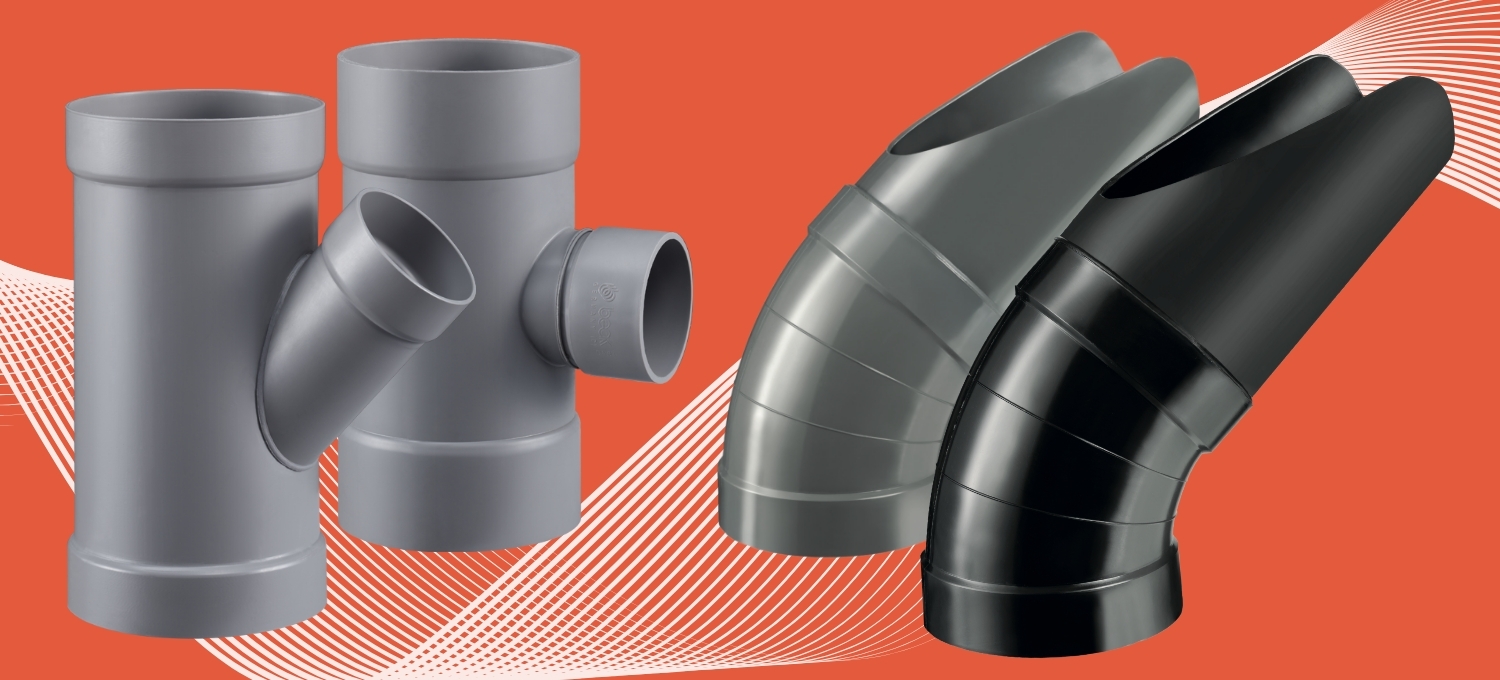
A saddle fitting or a T-fitting? This is a question that designers and installers of ventilation systems often ask themselves. The answer is simpler than you might think if you take a closer look at the different installation scenarios. That’s because the key difference lies not in the technology itself, but in the timing: Are you planning a new system, or do you need to retrofit a branch? This single question usually determines which solution is the right one. In this article, we’ll show you when each fitting is the more economical and technically superior choice for your project.
Before we dive into the decision criteria, here is a brief overview of the definitions of the fittings:
Saddle Fitting and T-Fitting: The Fundamental Difference
T-fitting (also: branch fitting)
A T-piece is a prefabricated fitting with three connections that is planned and installed during the initial installation of a ventilation system. It allows for a branch from the main line, which is part of the system design from the outset.
Saddle Fitting and Saddle Branch
A saddle piece is welded onto an already installed pipe to create an additional outlet. The saddle piece is therefore the ideal solution for retrofitting ventilation systems. The saddle fitting is the complete branching assembly, including the connecting spigot.
The key difference is this: The T-fitting is used during the design and initial installation of ventilation systems, when the branch connections are known from the outset. The saddle fitting, on the other hand, is the solution for retrofitting—it is welded onto existing pipes to create additional outlets at a later stage.
When is a T-fitting the right choice?
The T-piece really shines whenever you know from the start where branches are needed. During the planning phase, you have full control over the system, and that is precisely the T-piece’s strength. Here is an overview of the three most important potential scenarios:
Scenario 1: New installation in the planning phase
Are you planning a completely new ventilation system or a new system component? Then the T-piece is the first choice in most cases. Because it gives you:
- full control over placement and orientation
- optimal airflow guidance thanks to the appropriate T-piece geometry (e.g., 45°)
- easier installation, since everything is planned as a single integrated system
- often lower material costs for large-scale production
Real-world example:
A new production building for the chemical industry is being planned. All branch connections for exhaust systems on production lines are known. In this case, it makes no sense to use saddle fittings—T-fittings are faster to install and more cost-effective.
Scenario 2: Anticipated expansions
Even if not all branches are currently needed, but it is foreseeable that additional connections will be required in the future: T-fittings can be planned “in reserve” and initially sealed off. The advantage here: Activating them later is significantly easier than having to install a T-fitting retroactively or weld on a saddle fitting.
Scenario 3: High flow rates with known load
For very high flow rates and when precise flow direction is critical, T-fittings with optimized 45° branches offer an excellent solution that can be perfectly sized from the start.
When is a saddle pad the better option?
The saddle fitting is the solution for existing systems. Where a T-fitting would require extensive modifications, the saddle fitting really shines: it’s fast, flexible, and cost-effective. These three common scenarios make all the difference (examples):
Scenario 1: Existing system needs to be expanded
The most common situation: A ventilation system is already installed and in operation. Now a new machine, a new workstation, or an additional process step is being added that also needs to be extracted. Here, the saddle fitting is unbeatable, because it means you have:
- no need to dismantle existing ductwork
- only minimal system downtime
- a flexible solution—can be installed at any location
- no major modification work
Practical example:
An electroplating plant is expanding its production with two new tanks. The existing exhaust air duct already runs under the ceiling. Using saddle fittings, the two new branches can be connected within a few hours—without having to dismantle the entire ductwork or retrofit a T-fitting.
Scenario 2: Unplanned changes to the layout
Production processes change, machines are relocated, and new requirements arise. In reality, hardly any facility still matches the original plan after five years. This is where saddle fittings offer maximum flexibility: They can be installed where they are actually needed, regardless of the original planning.
Scenario 3: Retrofits without system downtime
When modernizing old systems, it is often not possible or economically feasible to replace the entire piping system. Saddle fittings allow for selective expansions while the rest of the system remains intact. This minimizes production downtime and keeps investment costs manageable.
Do you need assistance planning your specific application? We’re happy to advise you every step of the way.
Technical Aspects: Comparison of Flow Patterns in Saddle Fittings and T-Fittings
A frequently asked question is whether a T-fitting is generally better for flow than a saddle fitting. Here, too, the answer lies in the design:
T-fittings with a 90° outlet
Classic T-fittings with a right-angle outlet can lead to turbulence and increased pressure loss—especially at high flow rates. The abrupt change in direction disrupts the flow.
T-fittings with a 45° outlet
Flow-optimized T-fittings with a 45° outlet provide significantly better airflow and substantially reduce turbulence.
Modern saddle fittings with a seamless 45° bend
The latest generation of Beck saddle fittings uses a segment-free 45° bend that redirects the flow just as smoothly as a high-quality T-fitting—while generating up to 25% less pressure loss than conventional saddle fittings with segmented sections.
The result: Technically, modern saddle fittings are superior to a standard 90° T-fitting in terms of energy efficiency. They combine retrofitability with optimized flow guidance.
Learn more in our latest product catalog for saddle pieces and saddle fittings.
Retrofitting a T-fitting: When does it make sense?
The scenarios discussed so far clearly illustrate the appropriate applications for both solutions. However, in practice, the question sometimes arises: Isn’t it worth having a T-fitting retrofitted after all, rather than opting for a saddle fitting? The short answer: Technically, yes; economically, usually no. Retrofitting a T-fitting requires a considerable amount of effort: The system must be shut down, the affected pipe section completely dismantled, the T-fitting inserted, all adjacent pipe sections reassembled, and the entire section tested for leaks. This means several days of work, very high costs, and a shutdown that often lasts several days. Welding on a saddle fitting, on the other hand, takes only a few hours, incurs moderate costs, and results in minimal operational downtime.
There are, however, exceptions where retrofitting a T-fitting does make sense: during large-scale renovations when large parts of the system are being replaced anyway, when there are multiple branches close together, or when the pipe routing is being fundamentally changed. In 95% of cases, however, the saddle fitting is the more economical and faster solution for retrofits.
Cost Comparison: Saddle Fitting vs. T-Fitting
For new installations, the T-fitting is the more cost-effective choice: the material is 30–40% cheaper than that used for saddle fittings, and installation is part of the standard process without any extra effort. Using saddle fittings in new installations would be unnecessarily expensive.
For retrofits, the picture is completely different: Retrofitting a T-fitting incurs many times the cost of a saddle fitting—which is simply welded on—due to the necessary disassembly and reassembly—a clear economic advantage for the retrofit solution.
Even faster and more cost-effective: With Beck’s EffiTech plug-in system, both T-pieces and saddle fittings are available—completely without welding or gluing. Tool-free manual assembly significantly reduces installation time and saves on installation costs for both new systems and retrofits. The connections are absolutely leak-tight, reusable, and self-aligning.
The often-overlooked factor: energy costs over the service life. A 90° T-fitting with high turbulence permanently increases the fan’s power consumption, while a flow-optimized 45° saddle fitting saves several hundred euros in energy costs over 20 years. Modern saddle fittings with segment-free bends are often even more energy-efficient in ventilation systems than standard T-fittings. Therefore, calculate not only the purchase price but also the Total Cost of Ownership (TCO) over the entire service life.
Real-world cases: Saddle fitting or T-fitting? Here’s how others have decided
Case 1: New pharmaceutical facility → T-fitting
Situation: New production building with 12 defined extraction points
Decision: 45° T-fittings in the new design
Why: All branches known, optimal flow planning possible, quick installation
Cost: Approx. 15% cheaper than if saddle fittings were used
Case 2: Laboratory expansion → saddle fitting
Situation: Existing laboratory is receiving two new fume hoods
Decision: Saddle fittings with 45° bends (no option to retrofit T-fittings)
Why: Existing system remains in place, only selective expansion required, downtime under 4 hours
Cost: Approx. 70% cheaper than retrofitting T-fittings
Case 3: Production Hall Modernization → Combination
Situation: Old system is partially replaced and partially expanded
Decision: New main lines with T-pieces, connection of old areas with saddle pieces
Why: Efficiency for new sections, flexibility for existing sections
Cost: Optimal cost-benefit ratio
Material and design: Saddle fittings and T-fittings from Beck
At Beck, you can find both T-fittings and saddle fittings of the highest quality—available in 7 high-quality plastics (PVC, PVC-UV, PP, PPs, PPs-el, PVDF, PE) and all standard sizes—from DN 50 to DN 800 for saddle fittings, and up to DN 1400 for T-fittings. Whether for aggressive chemicals, UV radiation, electrostatic discharge, or standard applications—there is a suitable material for every requirement.
Quality Made in Germany: All fittings are machine-manufactured in accordance with DIN 4741 (minimum wall thickness 3 mm) and offer consistent precision throughout. We provide comprehensive CAD data and detailed flow calculations to assist with your planning.
FAQ at a Glance: The Most Frequently Asked Questions About Saddle Fittings vs. T-Fittings
1. What is the difference between a saddle fitting and a T-fitting?
A T-fitting is a prefabricated fitting designed for new installations and is planned for during the initial installation. A saddle fitting is welded onto existing piping after the fact.
2. Can I retrofit a T-fitting?
Yes, but the effort involved is considerable. You must dismantle the piping, insert the T-fitting, and reassemble everything. In most cases, a saddle fitting is the more economical alternative.
3. How much greater is the pressure loss with a saddle fitting compared to a T-fitting?
Modern saddle fittings with a seamless 45° bend have similar or better pressure loss values than standard 90° T-fittings. The geometry is the deciding factor, not the principle.
4. When is it worth retrofitting a T-fitting?
Only for large-scale renovations or when multiple branches are located close together. In 95% of cases, the saddle fitting is cheaper and faster.
5. Can I also use a saddle fitting in a new installation?
Technically yes, but economically it rarely makes sense. In new installations, T-fittings are cheaper and easier to install.
6. Which solution is more durable—a saddle fitting or a T-fitting?
With the same material and manufacturing quality, both are equally durable. The key factors are professional installation and the right material for the fluids.
7. Are there size limitations for saddle fittings and T-fittings?
At Beck, saddle fittings are available from DN 50 to DN 800 and T-fittings up to DN 1400. Please contact us for custom sizes.
8. How much does a saddle fitting cost compared to a T-fitting?
Saddle fittings are approximately 30–40% more expensive than T-fittings in terms of material cost. However, they are significantly more cost-effective for retrofits since no dismantling is required. Retrofitting a T-fitting often costs 5–10 times as much as a saddle fitting.
Planning Support: We help you decide between a saddle fitting and a T-fitting
Are you planning to expand your ventilation system or install a new one? Are you unsure whether you should retrofit a T-fitting or if a saddle fitting is the better choice? Let’s work together to find the best solution.